Forestry Mulching Cost Per Acre in Ohio
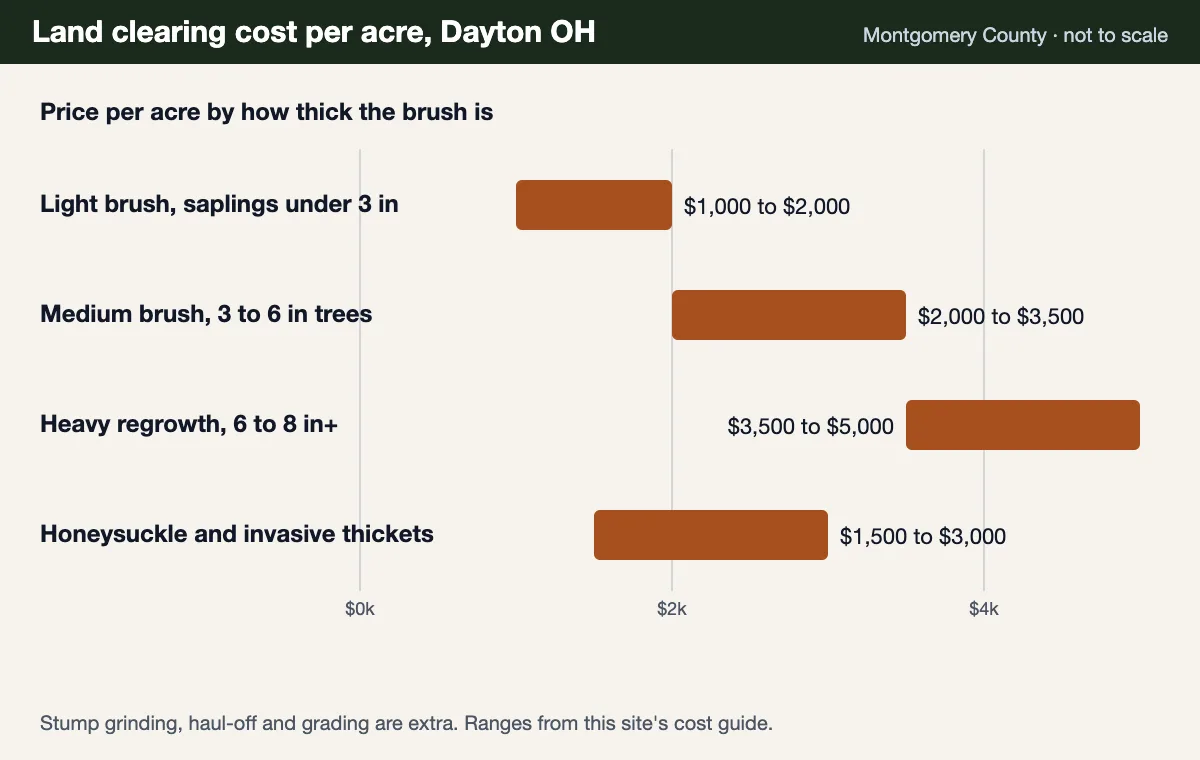
Typical residential forestry mulching in Ohio runs $1,500 to $3,500 per acre. The spread inside that range, and outside it at both ends, is driven almost entirely by what is standing on the ground rather than how much ground there is.
| Vegetation | Per acre | What that means on the ground |
|---|---|---|
| Light brush and saplings, under 3 in | $1,000 to $2,000 | Briars, young volunteer growth, a field edge that stopped being mowed a few years ago |
| Medium brush with 3 to 6 in trees | $2,000 to $3,500 | A woodlot understory left alone for roughly a decade |
| Heavy regrowth, 6 to 8 in and above | $3,500 to $5,000+ | Long abandoned ground carrying genuine small trees, not just brush |
| Invasive thickets | $1,500 to $3,000 | Honeysuckle and similar: small stems, extremely high stem counts per acre |
Source: published 2026 Ohio forestry mulching cost data from a north central Ohio operator. For a regional cross check, a northern Ohio contractor publishes $2,500 to $3,500 per acre for Medina County work, which sits inside the same band.
Why invasive thickets are not the most expensive band
It looks counterintuitive that a wall of honeysuckle prices below heavy regrowth, but the mechanics explain it. Mulching cost tracks how hard the head has to work per stem and how many stems there are. Invasive shrub stems are individually small, so the drum is never struggling, but there are an enormous number of them, so the machine covers ground slowly. Heavy regrowth is the opposite: fewer stems, each one genuinely demanding on the head. The two effects land the totals in overlapping ranges.
Hourly, Day Rate and the Minimum Charge
Per acre pricing only suits uniform ground. Where the density varies, the access is awkward or the shape is irregular, time based pricing is both fairer and usually cheaper, because the contractor is not pricing in a margin for uncertainty.
| Basis | Published Ohio range | When it is the right unit |
|---|---|---|
| Hourly | $150 to $400 per hour | Partial days, scattered work, tight or awkward access |
| Day rate | $1,500 to $3,000 per day | Machine, operator and insurance, typically clearing 0.5 to 2 acres |
| Minimum charge | $500 to $1,000 | Mobilisation, the cost of getting the machine to the property at all |
| Coverage | 0.5 to 2 acres per day | Density decides where in that range a given parcel lands |
Time based figures published for Ohio forestry mulching work. Day rates include the operator, which is a significant part of why they compare favourably with renting a machine yourself.
The minimum is not padding
A $500 to $1,000 minimum on a small suburban job frustrates people until they picture the logistics. A tracked carrier is trailered to your street, unloaded, walked to the work, run, walked back, loaded and taken away. That sequence costs the same on a quarter acre in Kettering as it does on two acres out past Germantown. For most residential Dayton lots the minimum is effectively the whole quote, and comparing it against a per acre rate is comparing two different things.
What Actually Moves Your Number
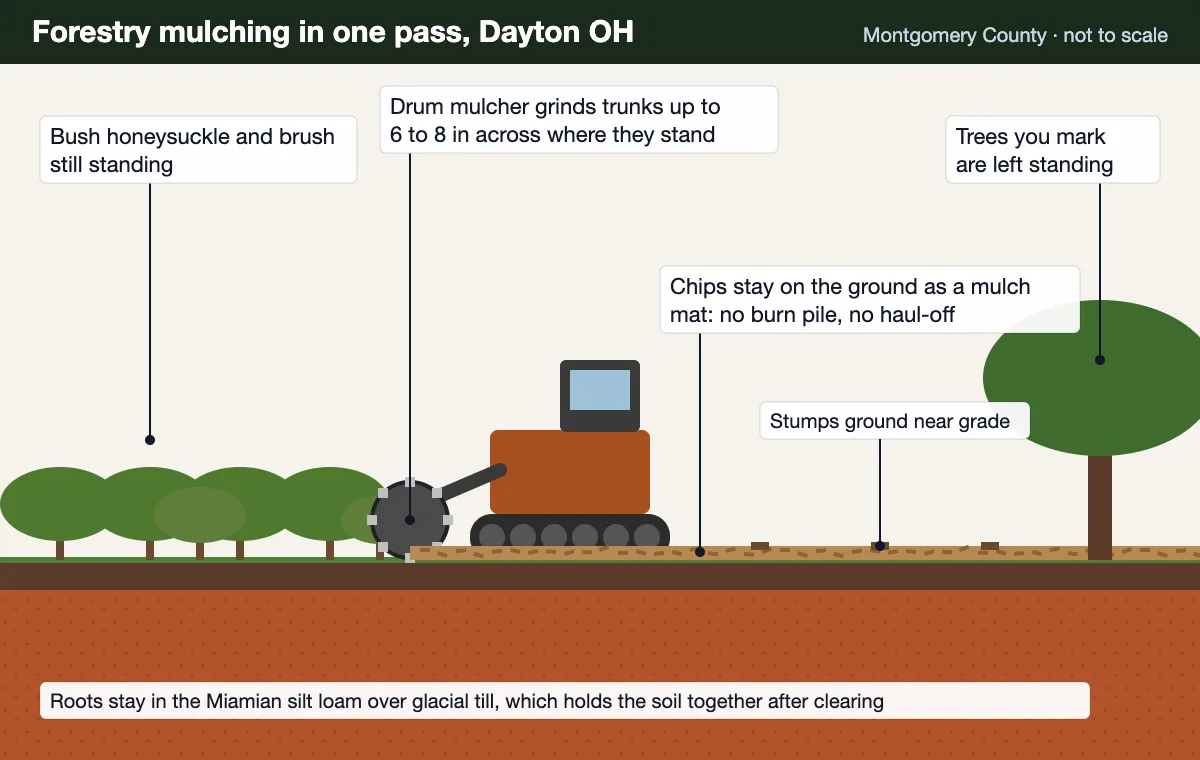
Stem diameter, first and by a distance
Two acres that look identical from the road can sit two bands apart. Thumb thick saplings and wrist thick stems demand completely different amounts of drum time per square foot. This is the single reason contractors will not price from satellite imagery.
Stems per acre
Density is the other half of the same calculation. An open woodlot with scattered brush and a solid invasive thicket both count as one acre, and one of them is a day while the other is two.
Access and parcel shape
A tracked machine arrives on a trailer and has to get in. Narrow gates, soft verges, low branches over the entrance and long thin parcels all add travel time that produces no cleared ground. A square two acres costs less than a two acre ribbon.
Keeper trees
Selectivity is a feature, and it costs time. An operator working around forty flagged trees clears less per hour than one working an open sweep. It is almost always worth paying for, but it is worth knowing it shows in the day count.
Ground condition and season
Saturated ground slows a machine, risks rutting, and sometimes stops a job entirely. The Miami soil series through this area carries a perched seasonal high water table 2 to 3 feet down from December through April. Frozen ground in the same window is ideal. Scheduling around that is free, and it protects the property.
Follow up on invasive stands
If the material is bush honeysuckle, budget for more than one visit. OSU Extension is explicit that simply cutting the shrub off at the base causes prolific sprouting and increases the number of stems. The first pass buys back the ground, and the second season decides whether it stays. Any quote that implies otherwise is not describing the plant accurately. The detail is on the honeysuckle removal page.
What About Renting a Mulcher Instead?
The published Ohio day rate of $1,500 to $3,000 includes the machine, the operator and the insurance, and that middle item is the one people underestimate. A mulching head is a high speed drum throwing wood chip, it needs a high flow carrier to perform, and feed rate and head height are skills built over many hours rather than an afternoon. Feed too fast and the drum stalls, too slow and the day evaporates.
We do not publish rental rates on this page because we have not verified a current local price we would stand behind, and quoting a number we have not checked would undermine everything else here. If you want to compare, price a local rental day plus transport plus your own time against the day rate above, and factor in that a rented machine on a first attempt clears considerably less ground than a day rate assumes.
Comparing Quotes Without Getting Caught Out
- The acreage or linear footage being worked, not just a lump sum
- Which density band the contractor has put your ground in, and why
- The finish height and what the chip layer will look like when they leave
- Which trees are being kept, named or flagged rather than assumed
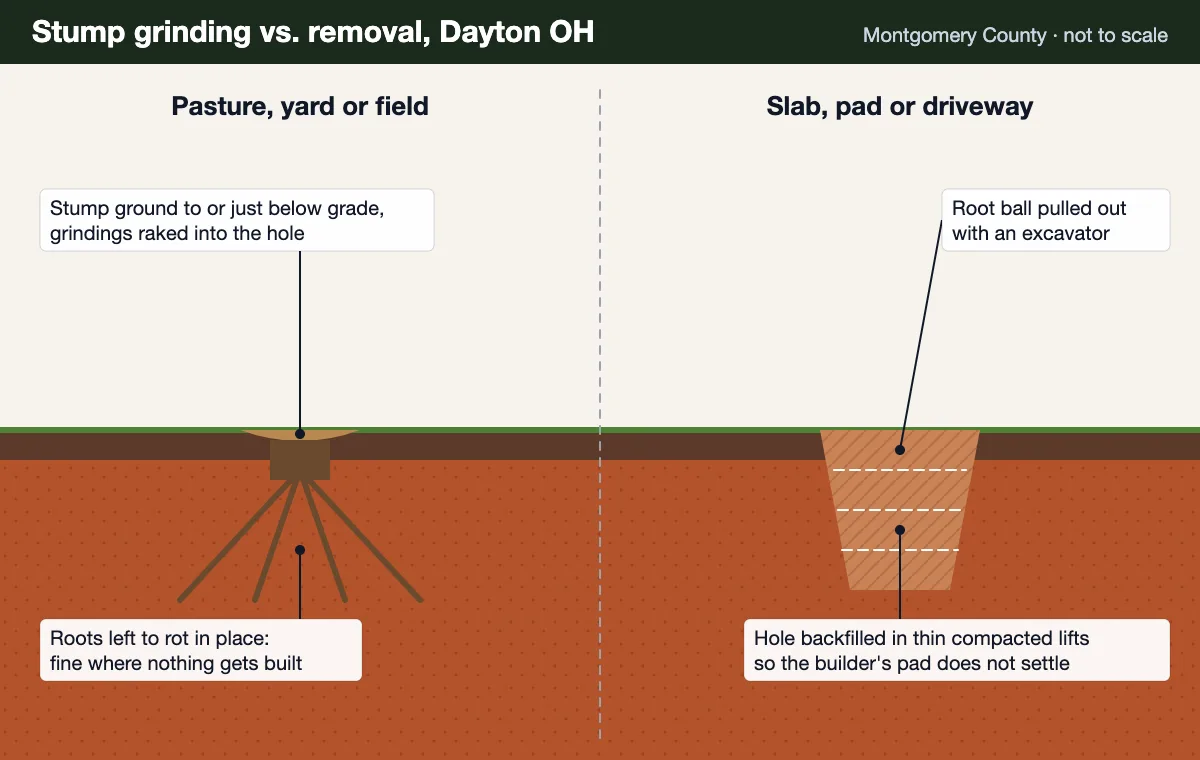
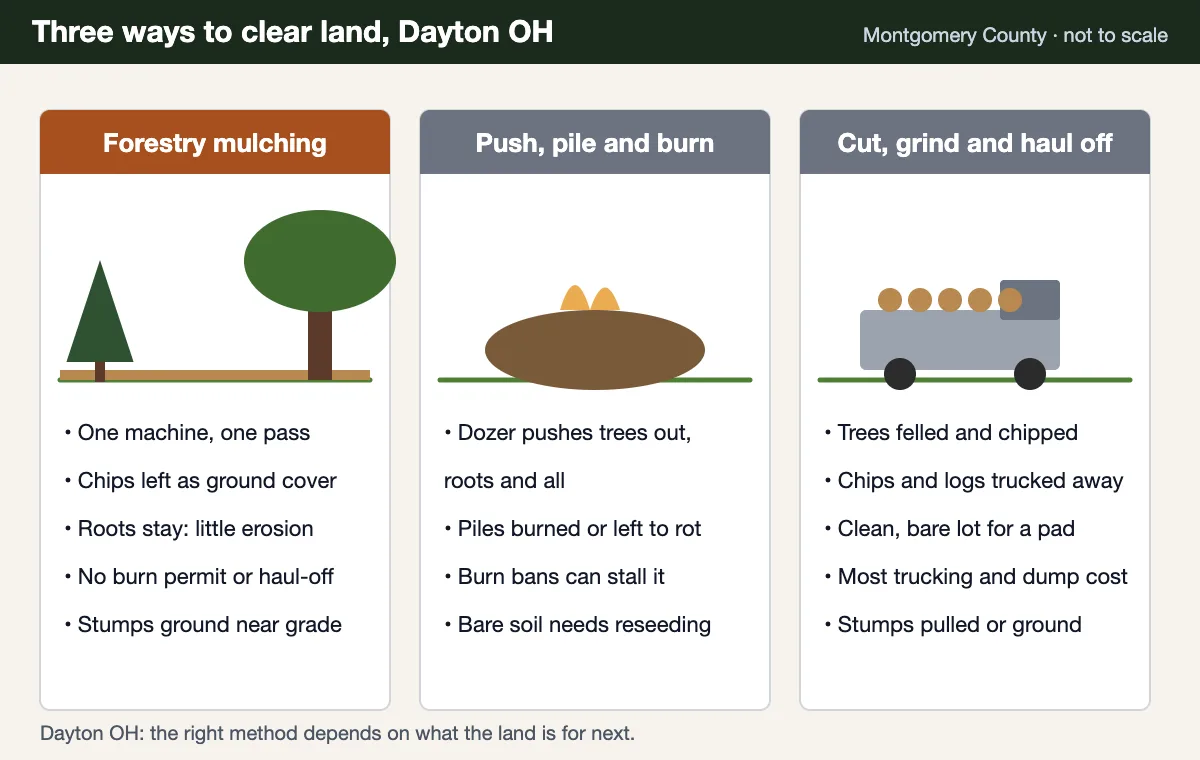
- Whether stumps stay, which with mulching they always do
- For invasive stands, what the follow up season requires and what it will cost
- Whether the project crosses the Ohio EPA one acre land disturbance threshold
- Proof of insurance, because a drum head throws material at speed
Where the Permit Question Changes the Budget
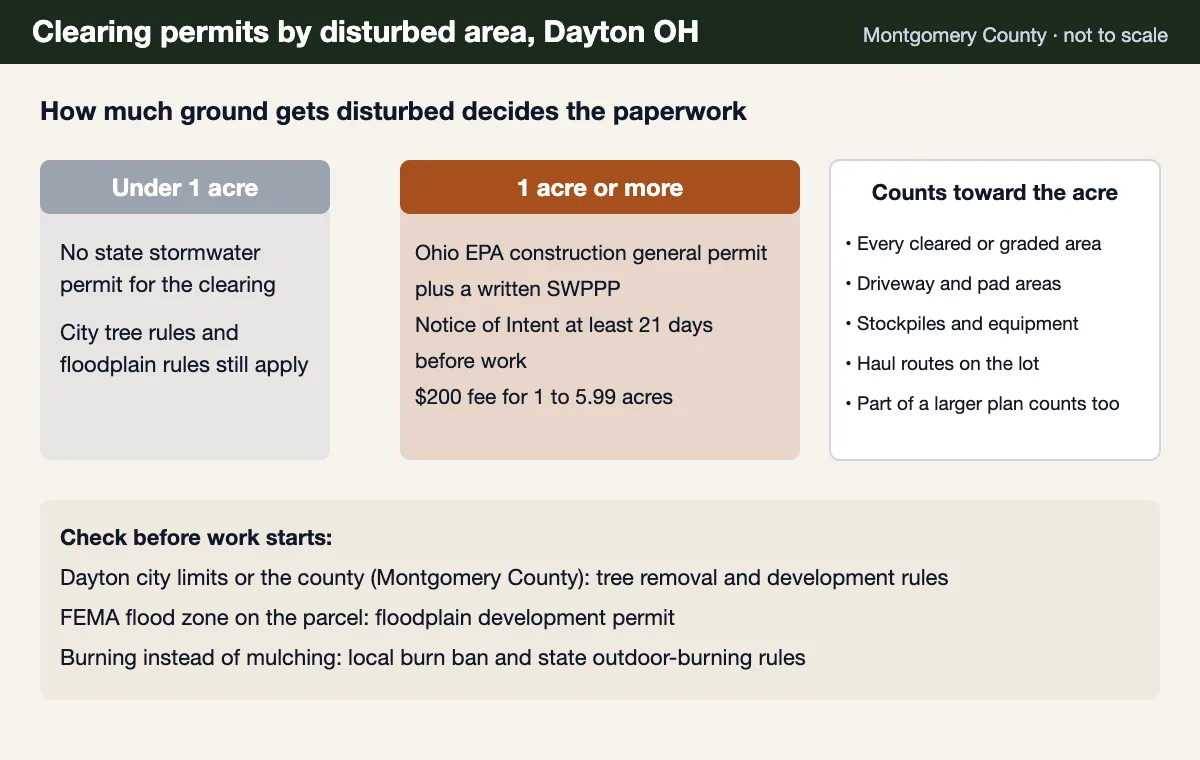
One cost that never appears in a per acre table: if your clearing is part of a construction project disturbing one acre or more, or part of a larger common plan of development or sale that will, Ohio EPA construction stormwater coverage applies. The Notice of Intent goes in at least 21 days before work starts and the base fee for sites of 1 to 5.99 acres is $200. Ohio EPA guidance states that clearing and grubbing activities are considered land disturbance, so the clearing itself counts. Full detail, with links to the agency pages, is in the Ohio land clearing permit and burning guide.
Sources
Ohio per acre, hourly, day rate and minimum figures: published 2026 Ohio forestry mulching cost breakdown, esforestrymulching.com/blog/forestry-mulching-cost-ohio. Regional cross check for Medina County: apxlandservices.com/blog/forestry-mulching-cost-medina-county-2026. Invasive shrub resprouting behaviour: Ohio State University Extension fact sheet F-68 on bush honeysuckle. Soil drainage and seasonal water table: USDA Official Series Descriptions for the Miamian and Miami series. Ohio EPA construction stormwater thresholds and fees, and Ohio open burning restrictions: Ohio EPA and the Ohio Administrative Code, all linked in the permit guide. Pricing sources are named rather than linked because they are commercial contractor pages rather than official data.
Ready to turn a band into a number? We cover Dayton and the surrounding towns listed on the service area page, the method is explained on the Dayton forestry mulching page, and you can send a parcel address through the contact form for a free on site walk.