Dayton Forestry Mulching Co.
Land Clearing, Miami Valley
Drum mulching head with carbide teeth on a compact track loader, the machine used for brush and fence line clearing around Dayton OH
Brush and Fence Lines

Brush Removal in Dayton, OH

Brush removal in Dayton OH for fence lines, field edges, ditch banks and access lanes that have closed in. We mulch the run in place so there is no pile to burn and nothing to haul, and we tell you honestly how long the line will stay open on your ground.

The Job Most Miami Valley Properties Actually Need

Brush removal is the smallest and most frequently deferred clearing job, and deferring it is what turns it into a land clearing job three years later. A fence line closes in from both sides. A field edge creeps inward 20 or 30 feet. A ditch bank grows over until water stops moving the way it used to. None of it happens fast enough to notice in any given month, and all of it is obvious once you compare a photo from five years ago.

Mulching suits this work particularly well because the volumes are modest and linear. There is no efficient way to pile and dispose of brush along a 900 foot fence run. There is a very efficient way to reduce it to chip where it stands and leave the chip distributed along the line.
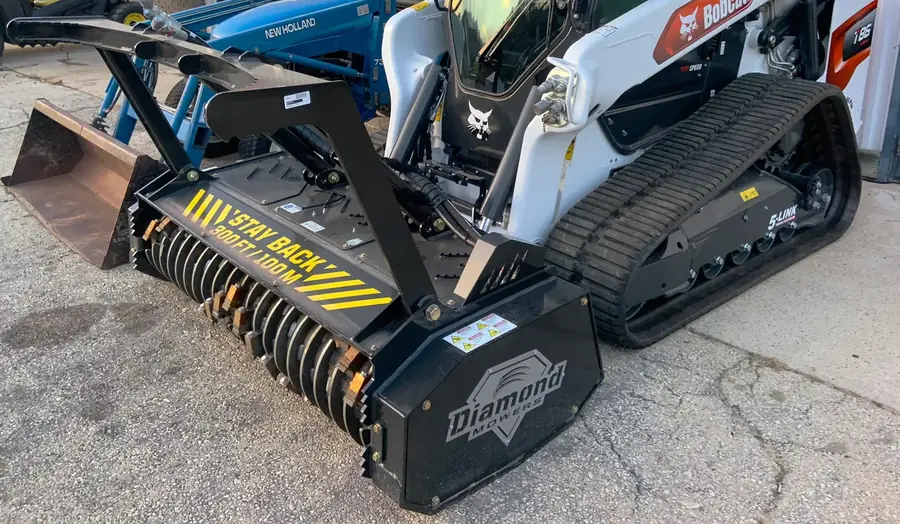
Drum mulching head fitted with carbide teeth on a compact track loader used for brush and fence line clearing near Dayton OH
The drum head that does the work. Its width is what makes linear fence line and edge runs efficient, since the machine clears a full swath per pass.

What We Clear on Brush Jobs

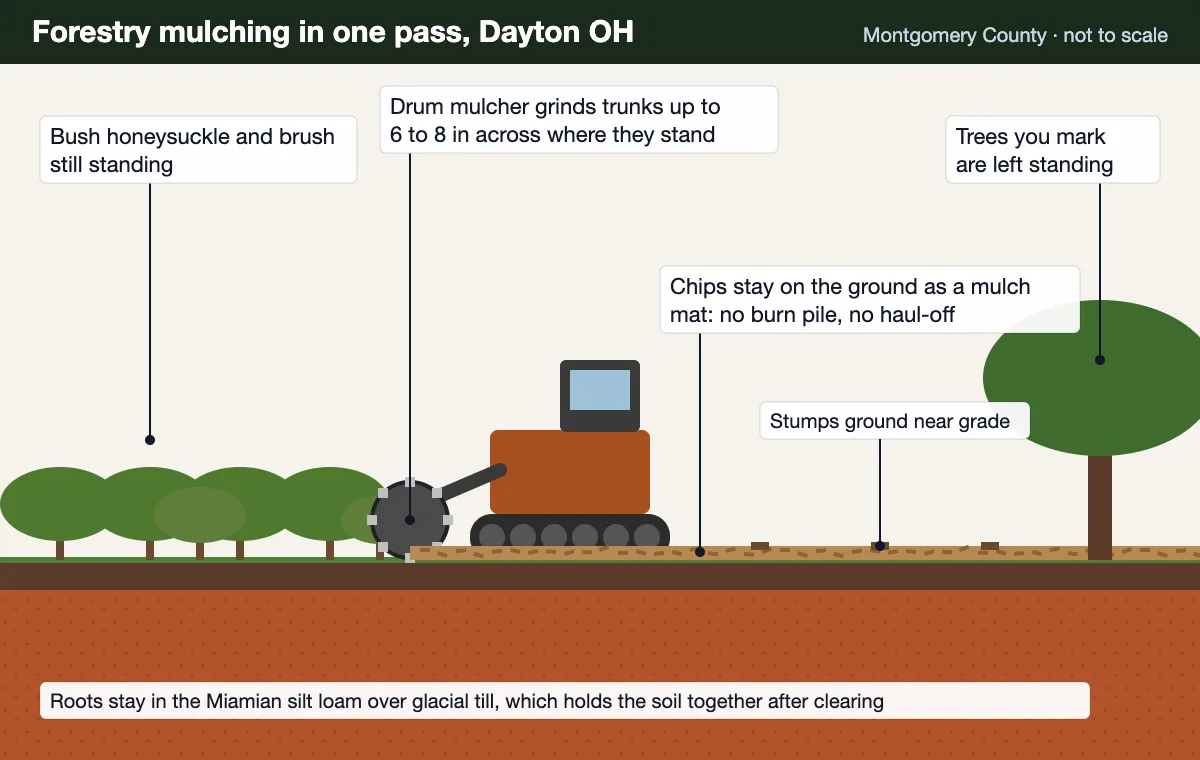
Brush removal Dayton OH with a forestry mulcher: brush ground in place, chips left as mulch, chosen trees kept
Brush removal in one pass: the understory is ground in place and the chips stay as ground cover, while the trees worth keeping are marked and left.

Fence lines

The most common call we get. Wire fence disappears under briars, saplings and honeysuckle within a few years of not being maintained, and once saplings grow through the wire the fence is effectively gone. Clearing the run makes the fence inspectable, repairable and mowable again. If the fence is beyond saving, say so and the job gets faster and cheaper, because we no longer have to work around it.

Field and pasture edges

Edges creep. A pasture that has not been grazed hard or bush hogged for a few seasons loses ground from the perimeter inward, and the material moving in is usually multiflora rose, briars, volunteer saplings and callery pear seedlings. Mulching resets the whole edge in a pass and gives you a line you can hold with a mower.

Ditch banks and drainage ways

Brush along a drainage way traps debris and changes how water moves through a property. Clearing it by mulching rather than scraping is the right call, because the chip left behind covers the bank surface instead of leaving bare soil exposed to the next storm. Anything that turns into actual digging goes through Ohio 811 first.

Access lanes and trails

Reopening a lane to a back parcel, a hunting access, a walking trail or a route to a barn or pond. Narrow, linear and straightforward for a mulching head. The width you agree at the start is the width you get, so decide whether you need a walking trail or something a truck fits down.

How a Brush Clearing Job Runs

Six steps. The width decision at step two is the one that determines whether you are calling us again in two years or in six.

  1. 1
    Walk the line

    Fence line and edge work is measured in feet, not acres, so we walk the run with you and note width, what is on both sides, and where the posts and pins actually are under the growth.

  2. 2
    Agree the finished width

    A mowable 8 foot strip and a 20 foot buffer are different jobs. Deciding the width up front is what stops the classic result where the edge closes back in within two seasons.

  3. 3
    Protect what is behind the brush

    Fence wire, posts, culverts, drain tile outlets, survey markers and irrigation are routinely invisible under a closed in edge. They get located and flagged before the head runs.

  4. 4
    Mulch the run in place

    The head reduces briars, saplings, vines and invasive shrubs to chip along the line. Nothing is dragged to a pile, so there is no burn stack sitting in a field waiting on an Ohio EPA burning window that may not come.

  5. 5
    Feather the edge

    A hard vertical wall of cut growth regrows fastest. Tapering the edge back slightly and leaving the chip spread gives a line that stays open longer and is far easier to maintain with a mower.

  6. 6
    Set the maintenance interval

    We tell you how long the run will realistically stay clear on your ground, and whether the regrowth is ordinary brush or invasive shrub that needs a different plan.

What Brush Removal Costs Around Dayton
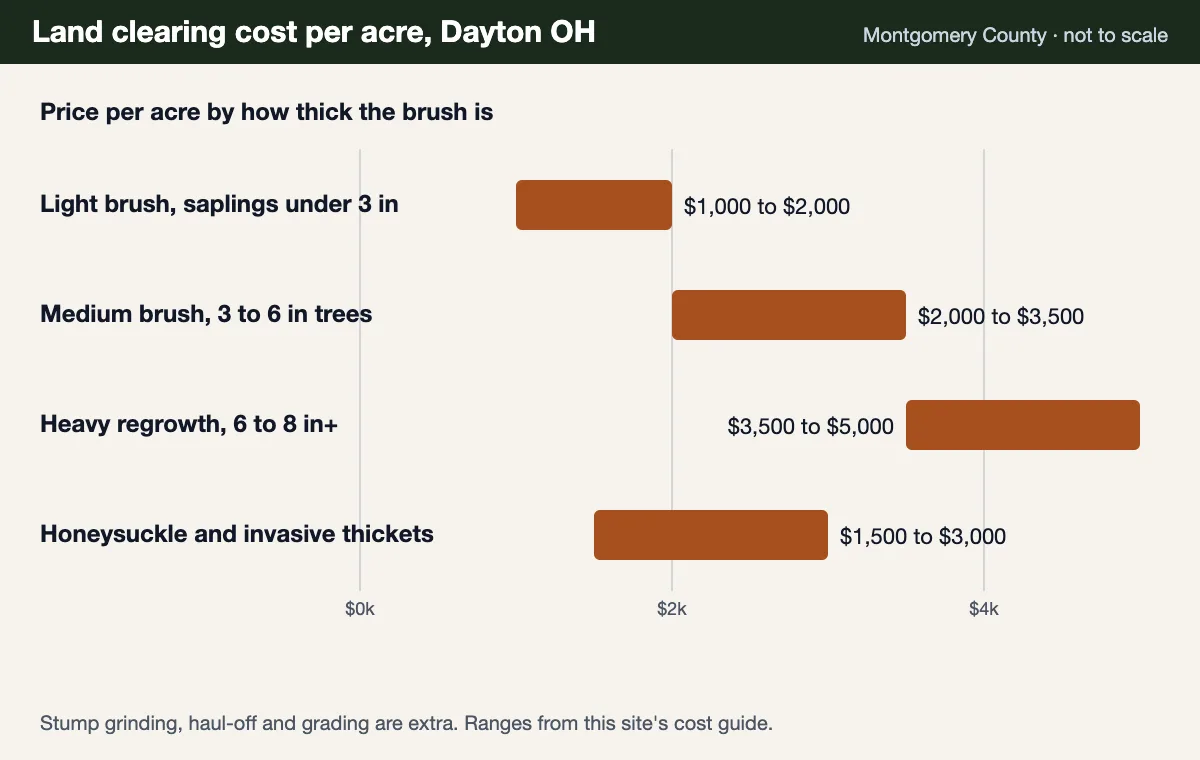
Brush removal cost Dayton OH per acre by density, from light brush to heavy regrowth
Per acre ranges published for Ohio work, by how thick the brush is. Small Dayton jobs often fall under the $500 to $1,000 minimum instead.

Linear brush work is normally priced by the hour or the day, because acreage is the wrong unit for a fence run. Published Ohio figures put mulching at $150 to $400 per hour and $1,500 to $3,000 per day including the machine, the operator and the insurance. Anything too small to fill a day meets the mobilisation minimum of $500 to $1,000, which is simply the cost of trailering a tracked machine to your property and back.

Where a brushy area is big enough to measure in acres, the standard bands apply: $1,000 to $2,000 per acre for light brush and saplings under 3 inches, and $1,500 to $3,000 per acre for invasive thickets. Most edge work sits at the light end unless the material has been left long enough to grow real stems. The full breakdown is in the cost guide.

What makes a brush job quicker and cheaper
  • Knowing roughly how long the run is before we walk it
  • Being clear about whether the fence is staying or going
  • Flagging any culverts, tile outlets, valves or markers you already know about
  • Access wide enough for a trailer and a tracked carrier to get in
  • Ground that is not saturated, which matters most from December through April
  • Grouping several runs into one visit rather than calling us back for each

Brush, or Something That Needs a Different Plan
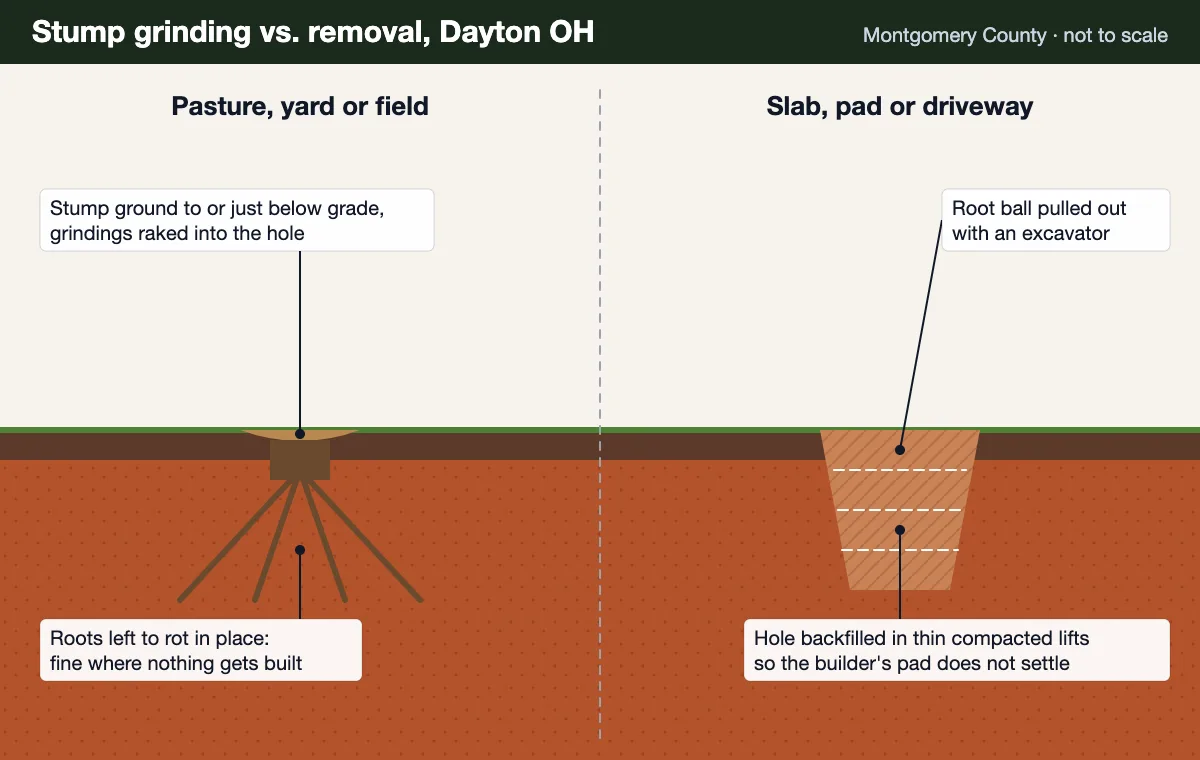
Stumps after brush removal in Dayton OH: ground near grade for a yard, pulled and backfilled for a building pad
Where the plan changes: mulching leaves stumps ground near grade, which is fine for a yard or woodlot but not under a new slab or driveway.

Worth checking before you book: if the material along your edge is bush honeysuckle or callery pear rather than ordinary brush, cutting it repeatedly will not hold the line. OSU Extension is clear that simply cutting the shrub off at the base causes prolific sprouting and increases the number of stems, so an invasive edge that gets bush hogged every year tends to get thicker rather than thinner. That job needs the approach on the honeysuckle removal page, not a repeat brush cut.

Equally, if the edge has already closed in far enough that you are talking about acres rather than feet, the job has become land clearing and is priced that way. The method is identical either way and is explained on the Dayton forestry mulching page.

Brush Clearing Across the Miami Valley

We take brush and fence line work across Montgomery, Greene, Warren and Miami counties, from suburban lot lines in Huber Heights and Kettering to long field runs out toward Germantown, Waynesville and Tipp City. Every town we cover is on the service area page, and you can send the run length and a photo through the contact form for a free look.

Get a Free Written Quote

Tell us where the property is and roughly what you're dealing with. You'll get a scope and a number in writing, with no obligation.

Fence line disappeared?

Tell us roughly how long the run is and what is on either side of it. We will walk it, agree a finished width, and put an hourly or day rate in writing.

  • A written scope that names the acreage, the stem sizes and what gets left standing
  • Mulched in place, so nothing is burned and nothing is hauled off your property
  • A realistic follow-up plan when invasives are involved, not a one visit promise
  • Ground conditions checked before we track a machine across wet ground
Get a Free Written Quote

Tell us where the property is and roughly what you're dealing with. You'll get a scope and a number in writing, with no obligation.

Brush removal in Dayton OH: frequently asked questions

How much does brush removal cost in Dayton OH?

Most fence line and edge work is priced by the hour or the day rather than the acre, because the job is linear. Published Ohio figures put mulching at $150 to $400 per hour and $1,500 to $3,000 per day with machine and operator. Anything too small to fill a day meets the mobilisation minimum of $500 to $1,000. Where a brushy area is large enough to measure in acres, light brush and saplings under 3 inches run $1,000 to $2,000 per acre and invasive thickets $1,500 to $3,000.

What is the difference between brush removal and bush hogging?

A bush hog cuts and leaves the stems lying on the ground, which is fine for grass and light annual growth but poor on woody material, where it leaves sharp cut stubs and a mat of whole stems. A mulching head reduces the material to chip, so there is nothing lying in the field afterwards and nothing to rake, pile or burn. On woody regrowth with real stems in it, mulching is the tool. On a pasture that just needs topping, a bush hog is cheaper and there is no reason to hire a mulcher.

Can you clear brush along a fence line without damaging the fence?

Yes, and that is largely down to locating the fence before the head runs. On a line that has been closed in for years the wire and posts are often invisible, so we walk it, find them and flag them first. The head is precise enough to work right up to a marked post. Where the fence is derelict and being replaced anyway, clearing it out is a faster and cheaper job, so it is worth telling us which situation you are in.

Stumps after brush removal in Dayton OH: ground to grade or pulled and backfilled
Stumps two ways: ground near grade where the ground stays open, pulled and backfilled where something gets built.
How often will the brush come back?

Ordinary brush along a Miami Valley field edge typically needs attention every three to five years if you want to hold the line, and annually if you mow the strip. Invasive shrubs are a different timeline: bush honeysuckle resprouts from the root crown, and OSU Extension notes that simply cutting at the base causes prolific sprouting and increases the number of stems. If the edge is honeysuckle or callery pear, plan on follow up treatment rather than repeat cutting alone.

Can I just burn the brush pile myself instead?

Inside Dayton city limits, generally no. The City of Dayton states that open burning is generally prohibited within the city, with just a few exceptions, or unless a permit has been issued. Outside municipal limits Ohio EPA rules require written agency permission before land clearing waste is burned and require fires to be at least 1,000 feet from inhabited buildings, and the Ohio Department of Natural Resources bans open burning between 6 a.m. and 6 p.m. in unincorporated areas during March, April, May, October and November. Mulching avoids creating a pile that needs disposing of at all.

Do you clear ditch banks and drainage ways?

Yes, and these are some of the most useful runs to keep open, because brush along a ditch traps debris and changes how water moves. A mulching head can work the bank without scraping it, which matters: the chip left behind holds the bank surface rather than leaving bare soil to wash. Where the work would involve any actual digging rather than clearing, that goes through Ohio 811 first and may bring in other rules depending on the watercourse.

Get your fence lines and field edges back

Free walk, written scope, and a realistic maintenance interval so the line does not close in again next season.

Get a Free Quote
Get a Free QuoteWritten estimate, no obligationSee Pricing