Forestry Mulching
The core service. A high speed drum head reduces brush, briars and saplings to a chip layer in a single pass, leaving mature trees standing and the ground covered.
Forestry Mulchingin Dayton OH →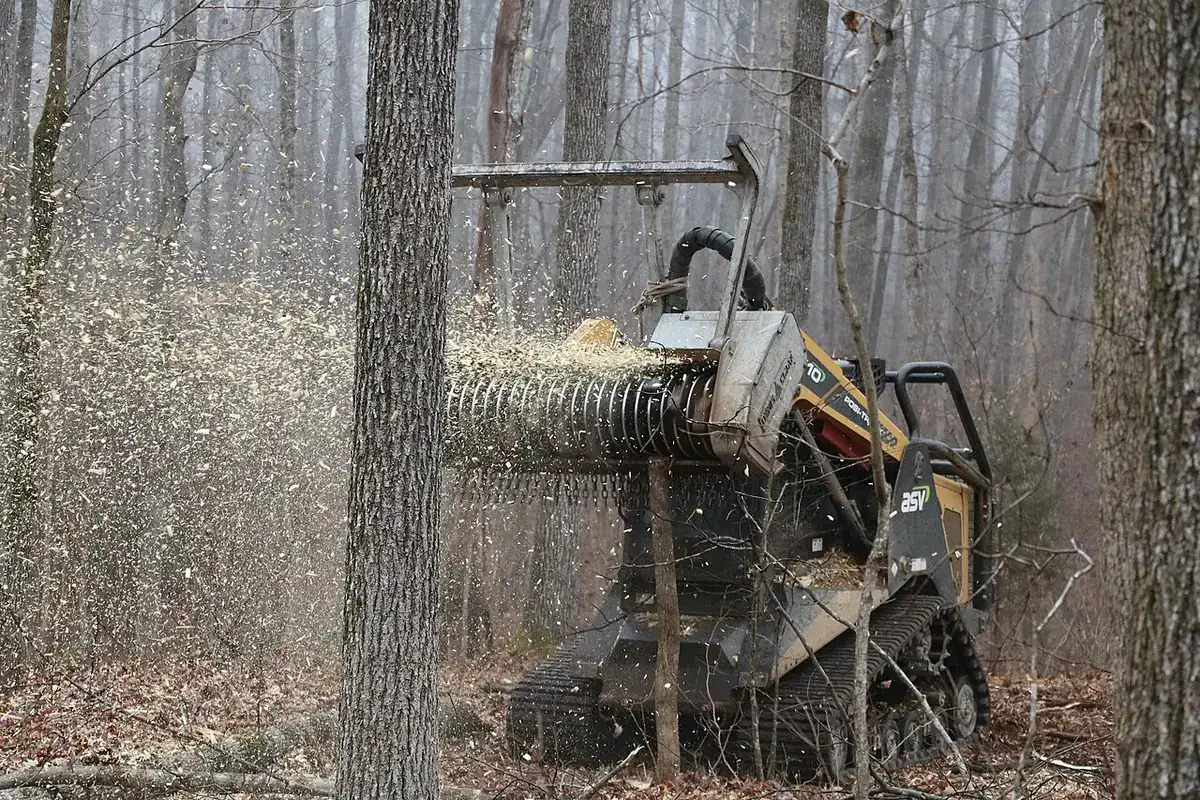
Forestry mulching in Dayton OH turns overgrown brush, saplings and invasive honeysuckle into a chip layer on your own ground, in one pass, with nothing burned and nothing trucked away. We work across Montgomery, Greene, Warren and Miami counties on everything from a half acre back lot in Kettering to a wooded parcel waiting on a build permit.
Most residential forestry mulching in Ohio runs $1,500 to $3,500 per acre, a mulcher clears roughly half an acre to two acres a day, and jobs too small to price by the acre fall on a $500 to $1,000 mobilisation minimum.
Four jobs cover almost everything property owners call us about in the Miami Valley. They use the same machine and the same principle, which is reducing standing vegetation to chip on site rather than cutting it, piling it and moving it. What changes between them is what you are trying to end up with.
The core service. A high speed drum head reduces brush, briars and saplings to a chip layer in a single pass, leaving mature trees standing and the ground covered.
Forestry Mulchingin Dayton OH →Opening a wooded or overgrown parcel ahead of a build, a driveway, a pasture or a shop pad. Where the one acre Ohio EPA stormwater question usually comes up.
Land Clearingin Dayton OH →Amur, Morrow and Tartarian bush honeysuckle, plus escaped callery pear. Cleared fast, with an honest follow up plan because the root crowns survive a cut.
Honeysuckle and Invasive Removalin Dayton OH →Reclaiming fence lines, field edges, ditch banks and access lanes that have closed in. The smaller, faster job that keeps a property from going back to woods.
Brush and Fence Line Clearingin Dayton OH →Forestry mulching is one machine doing in a single pass what used to take a crew, a chipper, a dump truck and a disposal site. A high speed rotating drum, fitted with carbide teeth or fixed knives, is mounted on the front of a compact track loader or on the arm of an excavator. The operator feeds standing vegetation into the drum and it comes out the back as wood chip, which falls straight to the ground it grew on.
The difference from every other clearing method is what happens to the material. A dozer pushes it into piles that then have to be burned or hauled. A chipper needs every stem cut and carried to it. A brush hog cuts but leaves whole stems lying. A mulching head eliminates the handling step entirely, and that is where most of the cost of clearing land has always lived. It is also selective: because the head only touches what the operator aims it at, you can take out an entire understory and leave the mature canopy standing.
Two things decide whether a mulching head performs: carrier flow and operator feel. The head is hydraulically driven, so a carrier that cannot supply high flow will bog the drum the moment it meets real material, and a drum fed too fast stalls while one fed too slowly wastes the day. That learning curve is why a rental machine is a poor bet for a one off homeowner job, and why published Ohio day rates include the operator.

A drum style mulching head on a compact track loader. The teeth on the drum reduce standing stems to chip, and the guard bar is there because the drum throws material at speed.
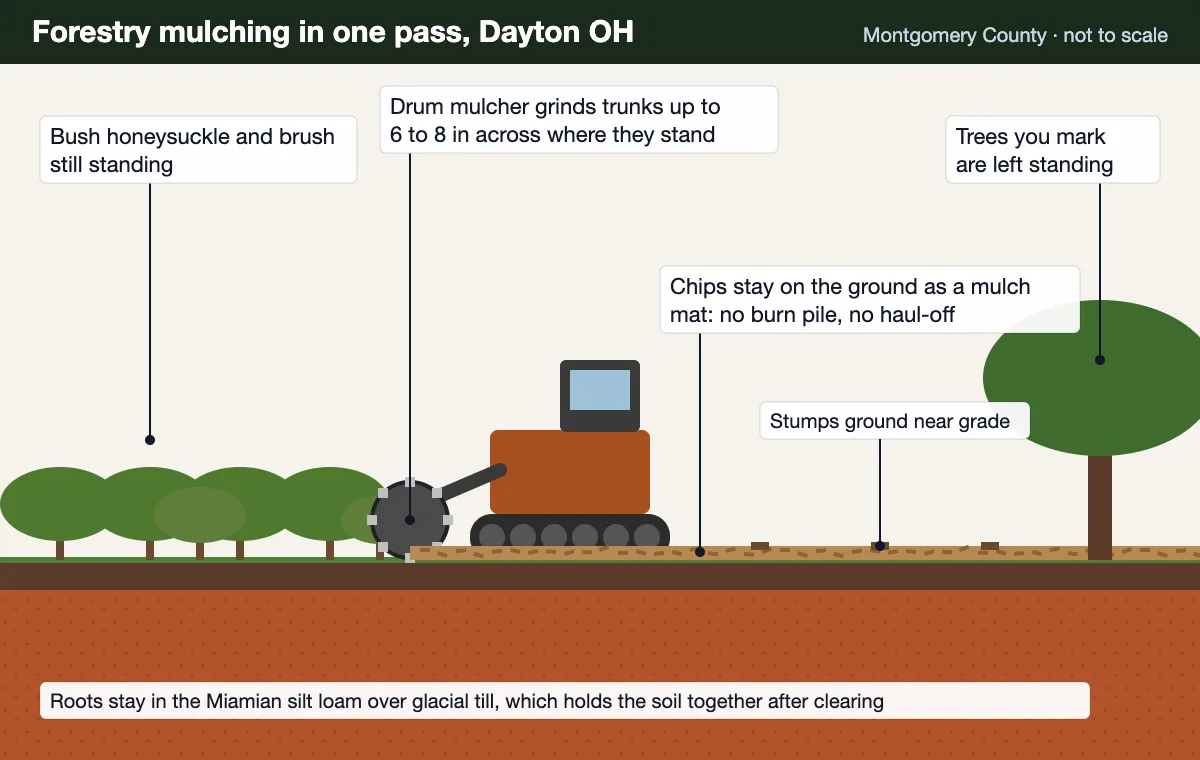
Every job runs the same six steps, in the same order, because skipping any of them is how properties get damaged. The walk at the start is what makes the number at the end honest.
We meet you on the ground and look at stem size, stems per acre, slope, access width and what you want left standing. That walk is what turns a guess into a density band, and it is free.
Mature trees you want kept, drainage features, septic fields, survey pins, fence posts and property corners get flagged before a machine moves. A mulching head does not undo a mistake.
Anything involving digging or stump work goes through Ohio 811 first. We also check ground condition, because a saturated December to April week on a perched water table will rut a parcel that would have been fine a month earlier.
You get the acreage, the density band, the finish height, what gets left, the day count and the price on paper before anyone starts. No verbal numbers.
The drum head reduces standing brush, briars and saplings to chip where they stand. Nothing is stacked, nothing is burned, nothing leaves the property. On dense stands we take two passes rather than force feed the head.
The chip layer gets spread out rather than left in windrows, so it holds soil instead of channelling water. We walk it with you at the end, and if invasives were involved we tell you what the follow up season needs to look like.
We do not publish a maximum stem diameter here because machine ratings vary by head and carrier, and quoting a number we have not verified for the specific setup would be guesswork. On the walk we tell you what the head will take on your ground.
Mulching wins here mostly because the alternatives are restricted. Open burning is generally prohibited within the city of Dayton with only a few exceptions or a permit, and Ohio EPA rules require written agency permission before land clearing waste is burned anywhere in the state. Outside municipal limits the Ohio Department of Natural Resources bans daytime open burning (6 a.m. to 6 p.m.) in unincorporated areas through March, April, May, October and November, which removes most of the working day in the season people actually want to clear in.
Hauling is the other option, and it is the expensive one. Every stem has to be cut, dragged, chipped or loaded, trucked and tipped. Each of those is a separate cost and a separate day. Mulching collapses the whole sequence into one machine making one pass, and what would have been the disposal problem becomes a chip layer that holds soil in place on a slope instead.
That chip layer is not decorative mulch and we do not pretend it is. It is coarse, it settles over a season or two, and on a heavily wooded parcel it can lie several inches deep. On most properties that is exactly what you want, because bare disturbed soil on a Miami Valley slope is how you get a washout after the next storm.
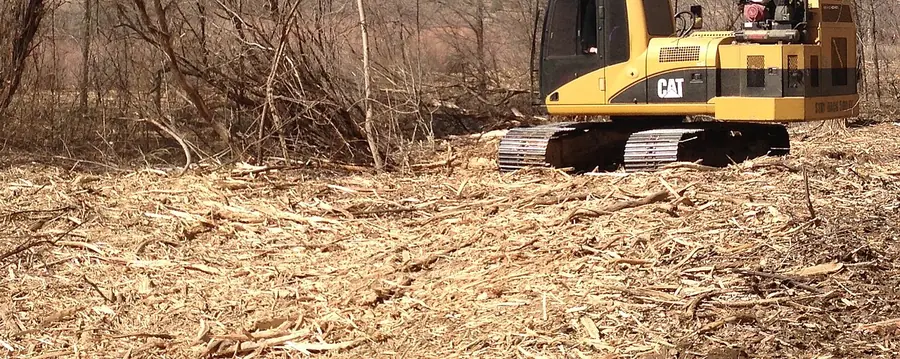
The finished surface after a mulching pass: chip laid flat over the ground it came from, with an excavator mounted head working the standing material behind it.
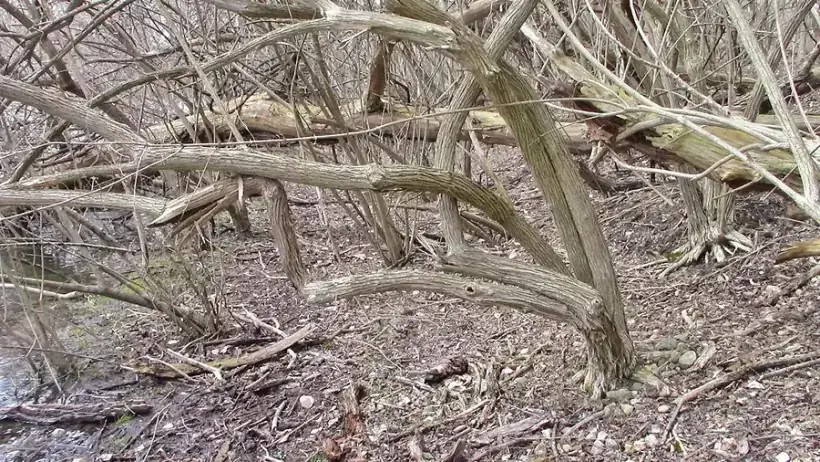
Bush honeysuckle taking over the subcanopy along a Midwest river corridor. OSU Extension describes these stands as pure, dense thickets totally void of other vegetation.
Invasive bush honeysuckle is the single most common reason a Dayton area woodlot becomes impassable. OSU Extension identifies Amur, Morrow and Tartarian honeysuckle, along with the hybrid known as Bella, as the problem species in Ohio forests. They leaf out earlier in spring and hold their leaves later into fall than most native trees and shrubs, which lets them shade out everything beneath them and form pure, dense thickets totally void of other vegetation.
Callery pear is the other one worth naming. Ohio listed Pyrus calleryana as an invasive species under the Ohio Administrative Code and prohibited its sale and distribution from January 7, 2023, making Ohio the first state to ban it. The ornamental trees planted decades ago escaped into field edges and fence lines, and the thorny wild seedlings they produce are now a standard part of what a mulching head is asked to clear here.
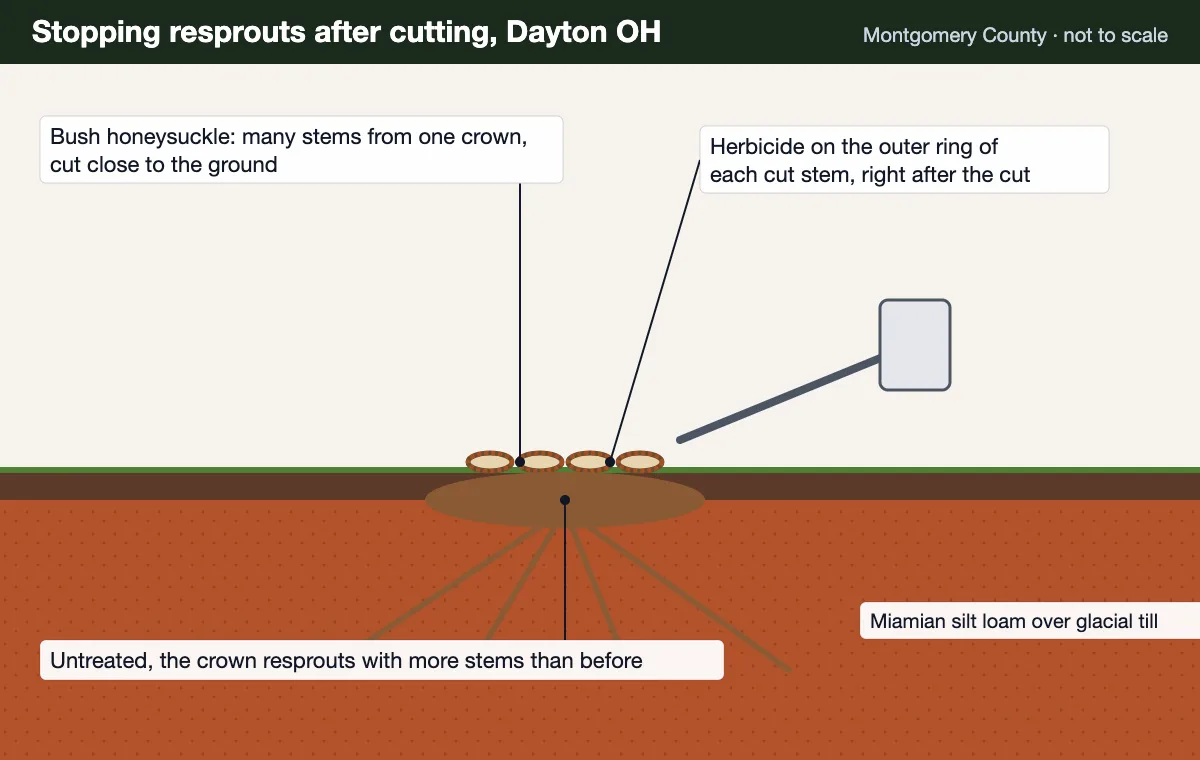
The honest part, which most contractor sites leave out: mulching clears the stand, it does not eradicate it. OSU Extension states plainly that simply cutting the shrub off at the base will cause prolific sprouting and increase the number of stems. Read the full picture on bush honeysuckle in the Miami Valley, or go straight to honeysuckle removal in Dayton OH.
Montgomery County is the type location for the Miamian soil series, which means the soil that defines this series nationally was described right here. Miamian soils are well drained, formed in up to 18 inches of loess over loamy till, moderately deep to dense till, with carbonates showing between 18 and 40 inches and slopes anywhere from 0 to 50 percent. On the well drained upland positions, a tracked mulcher can usually work year round.
The related Miami series is where scheduling gets real. Miami soils are only moderately well drained and carry a perched seasonal high water table 2 to 3 feet below the surface from December through April. They sit in a drainage sequence with the somewhat poorly drained Crosby and Conover soils and the poorly drained Brookston soils that fill the depressions. Put a heavy tracked machine across saturated ground in that window and you get ruts you will be fixing afterwards.
So we look at the parcel before committing to a date. Frozen or firm winter ground is genuinely the best condition for this work, and it coincides with the season the canopy is down and you can see what you are dealing with. A saturated February week is the worst. You can check your own ground on the cost guide where the density bands are laid out, and we walk it with you either way.
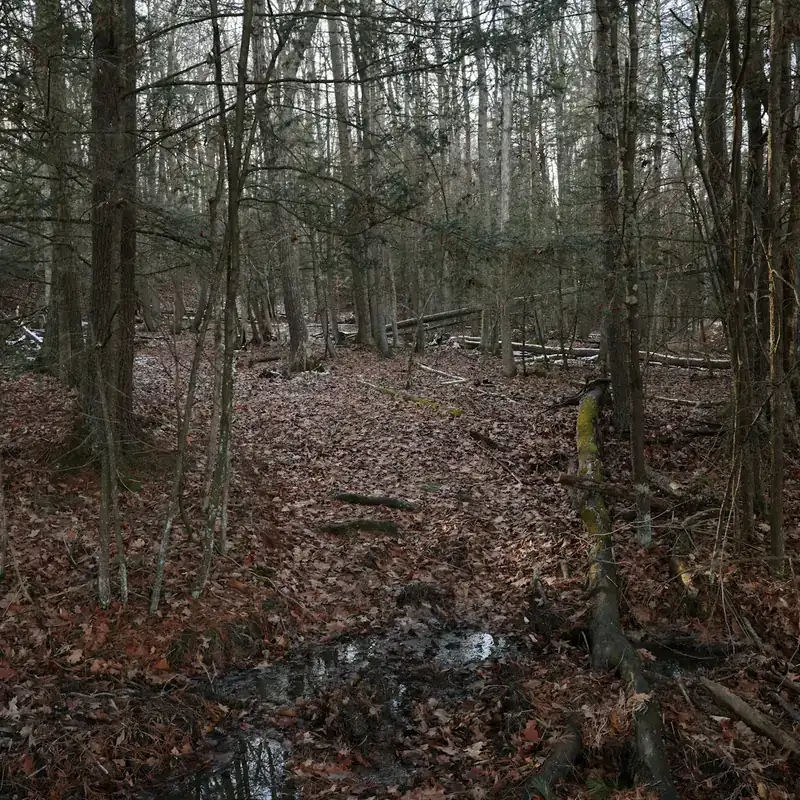
Standing water on a dormant season woodland floor. This is the condition a perched water table produces, and the reason we check ground before scheduling.
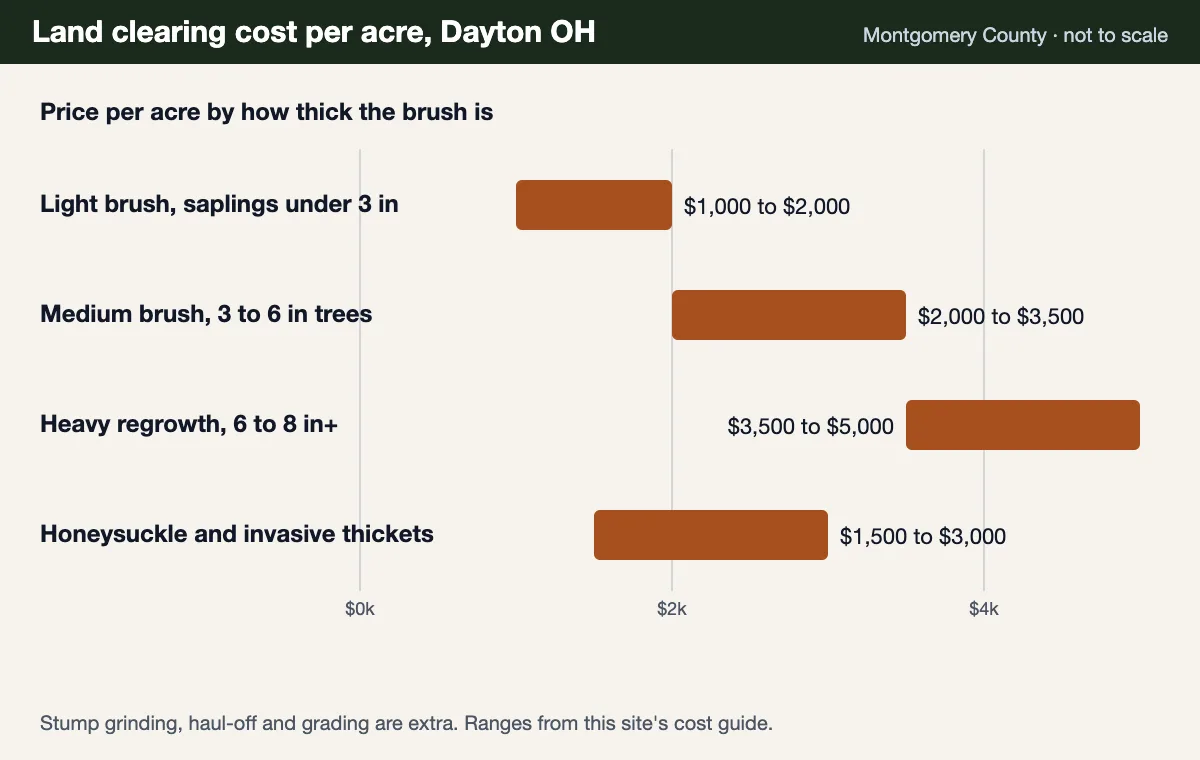
Most residential forestry mulching in Ohio falls between $1,500 and $3,500 per acre, and stem diameter moves that number far more than acreage does. These are published Ohio ranges rather than a quote on your property, because the only honest way to price a parcel is to walk it.
| Vegetation | Per acre | What it looks like |
|---|---|---|
| Light brush and saplings under 3 in | $1,000 to $2,000 | Field edges, young volunteer growth, briars, a lot you mowed a few years ago |
| Medium brush with 3 to 6 in stems | $2,000 to $3,500 | A woodlot understory that has been left alone for roughly a decade |
| Heavy regrowth, 6 to 8 in and up | $3,500 to $5,000+ | Long abandoned ground with genuine small trees, not just brush |
| Invasive thickets | $1,500 to $3,000 | Honeysuckle and similar: small stems, extreme stem counts per acre |
| Hourly | $150 to $400 per hour | Partial days, awkward access, odd shaped work |
| Day rate | $1,500 to $3,000 per day | Machine, operator and insurance, typically 0.5 to 2 acres cleared |
| Minimum charge | $500 to $1,000 | Mobilisation: getting the machine to the property at all |
Ranges published for Ohio forestry mulching work, not Dayton specific quotes. Density, slope, access and how much mature timber has to be worked around all shift the final figure.
If two or three of these describe your ground, mulching is almost certainly the cheapest way back. Most Dayton area properties reach this point in five to ten years of being left alone.
We work out of Dayton across Montgomery, Greene, Warren and Miami counties. The suburbs and the rural fringe need different things from the same machine: a Centerville back lot is a honeysuckle problem, a parcel out past Germantown is usually acreage. Both get the same written scope before anyone starts. See the full service area or send us the address through the quote form.
Three guides covering what actually decides a clearing project here: what it costs, what Ohio requires before you disturb ground or light a fire, and how to deal with the invasive shrub that caused the problem in the first place.
Published Ohio per-acre ranges broken out by stem diameter and density, plus hourly rates, day rates, acres per day and what a mobilisation minimum actually covers. Every figure carries its source.
Read guide →Ohio EPA counts clearing and grubbing as land disturbance, which pulls one acre and up into a construction stormwater permit. Plus why you cannot simply burn the brush inside Dayton city limits.
Read guide →How to identify Amur, Morrow and Tartarian honeysuckle, why cutting alone makes the stand worse, and what a realistic multi season control plan looks like. Grounded in OSU Extension fact sheet F-68.
Read guide →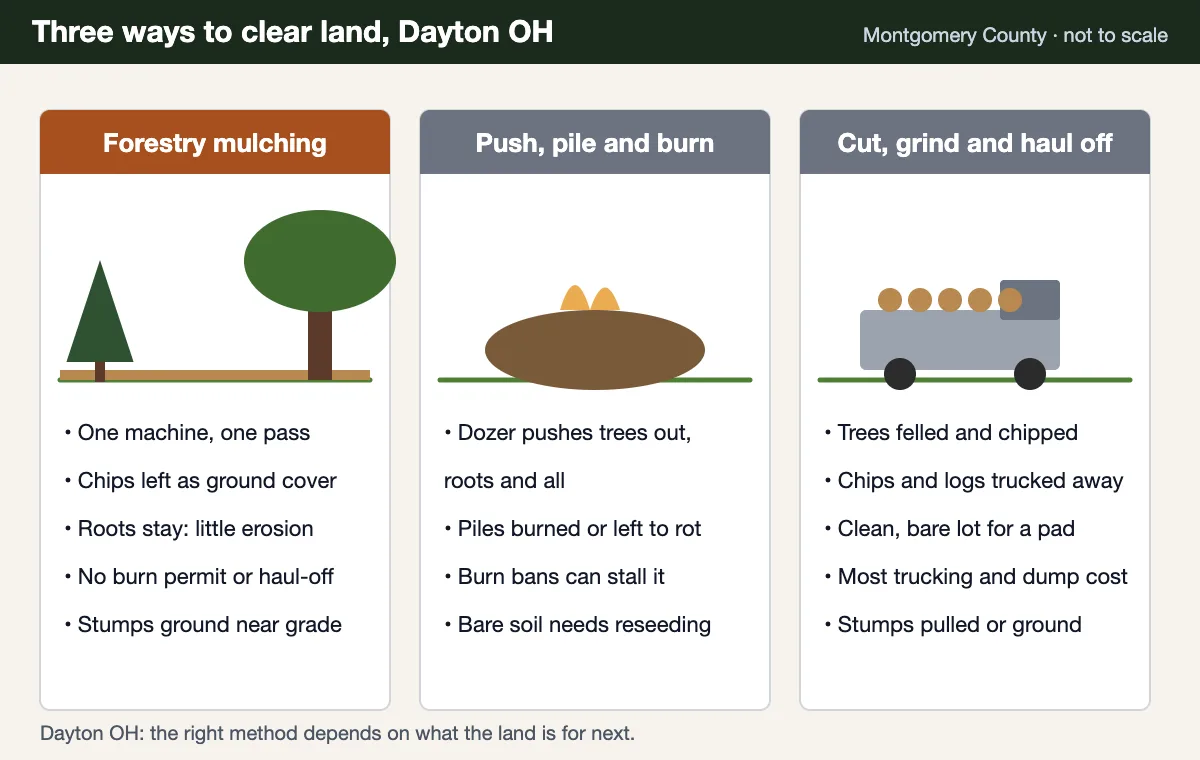
Most residential forestry mulching in Ohio runs $1,500 to $3,500 per acre, with published Ohio ranges of $1,000 to $2,000 per acre for light brush and saplings under 3 inches, $2,000 to $3,500 for medium brush carrying 3 to 6 inch stems, and $3,500 to $5,000 or more for heavy regrowth at 6 to 8 inches and above. Stem diameter and stems per acre drive the number far more than total acreage does. Small jobs usually meet a mobilisation minimum of $500 to $1,000 instead, because moving a tracked machine to the property costs the same whether it works a quarter acre or two.
In Dayton it usually is, because the two alternatives are both restricted here. Open burning is generally prohibited inside Dayton city limits unless a permit has been issued, and Ohio EPA treats land clearing waste burning as something that needs written permission from the agency even outside city limits. That leaves hauling, which means chipping or loading every stem, trucking it, and paying tipping fees. Mulching processes the same material where it stands and leaves it on the ground as a chip layer, so you pay once for one machine instead of paying for cutting, loading, trucking and disposal.
Yes, bush honeysuckle can and usually does resprout after it is cut or mulched. OSU Extension is explicit that simply cutting the shrub off at the base will cause prolific sprouting and increase the number of stems, because the root crown survives and pushes new growth. Anyone promising that one mulching pass eradicates a honeysuckle stand is overselling it. A realistic plan is mulching to knock the thicket down and open the site, then follow up treatment of the cut stumps or the regrowth, and monitoring for at least a year, which is the window OSU recommends.
Invasive thicket work in Ohio is published at $1,500 to $3,000 per acre, sitting inside the general mulching range because honeysuckle stems are small but extremely dense. A typical suburban back lot in Kettering or Centerville is well under an acre, so those jobs usually land on the $500 to $1,000 mobilisation minimum rather than a per acre figure. Budget separately for follow up, because the first pass clears the stand and the second season is what actually keeps it down.
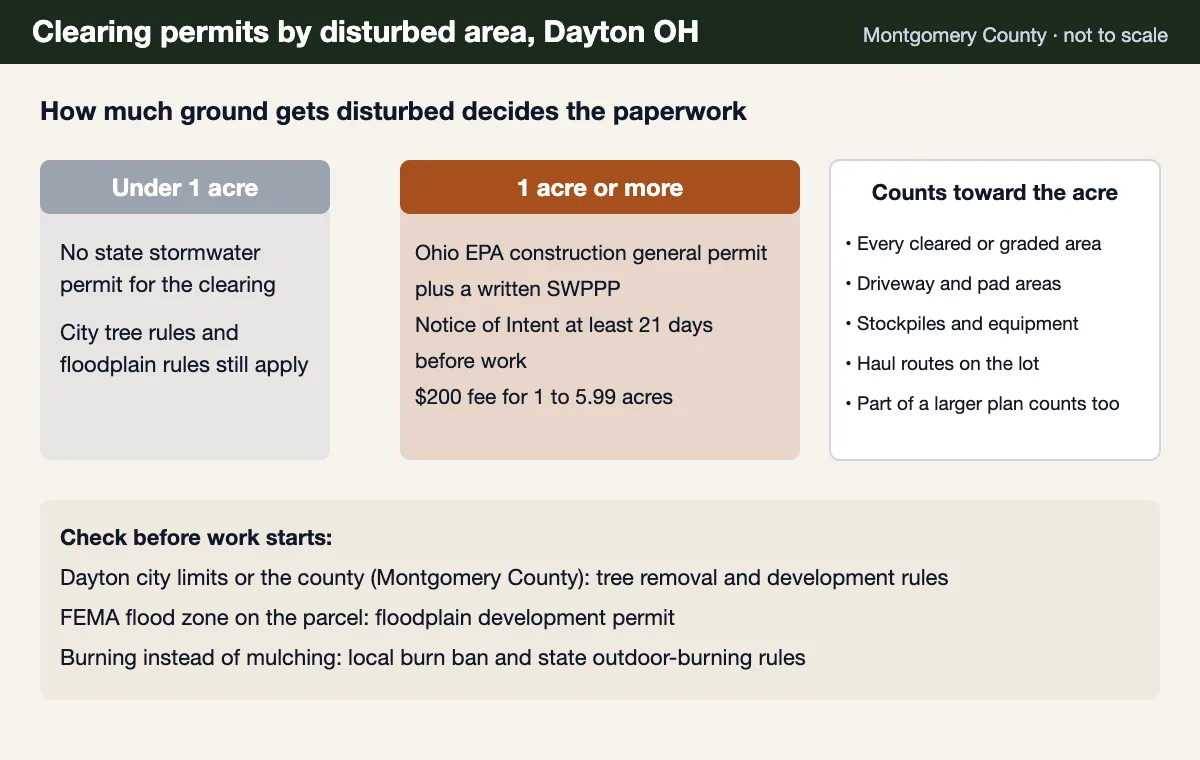
You need an Ohio EPA construction stormwater permit if your project disturbs one acre or more, or is part of a larger common plan of development or sale that will ultimately disturb one acre or more, and stormwater from it reaches waters of the state. Ohio EPA’s own small business guidance states that clearing and grubbing activities are considered land disturbance, so clearing ahead of construction counts toward that acre. The Notice of Intent goes in at least 21 days before work starts, and the base fee for sites between 1 and 5.99 acres is $200. Maintenance style clearing that is not part of a construction project is treated differently, and local zoning or township rules can still apply on top.
Not inside Dayton city limits without a permit. The City of Dayton states that open burning is generally prohibited within the city, with only a few exceptions or unless a permit has been issued. Outside municipal limits, Ohio EPA rules prohibit open burning of land clearing waste unless the agency gives written permission, require fires to be at least 1,000 feet from inhabited buildings, and the Ohio Department of Natural Resources bans open burning between 6 a.m. and 6 p.m. in unincorporated areas during March, April, May, October and November. That seasonal ban covers the exact months most people want to clear, which is a large part of why mulching in place has taken over here.
Send the address and a sentence about the ground. We will walk it, tell you which density band it falls in, and put a scope and a number in writing before anyone starts a machine.
No obligation, no pressure, and a real scope rather than a number over the phone. If mulching is the wrong tool for what you are trying to do, we will tell you that too.
Get a Free Quote