What it costs per acre in Ohio, whether honeysuckle really grows back, when Ohio requires a permit before you clear, why you cannot simply burn the brush here, and when in the year the ground will actually carry a machine. Answers first, sources named.
How much does forestry mulching cost per acre in Ohio?
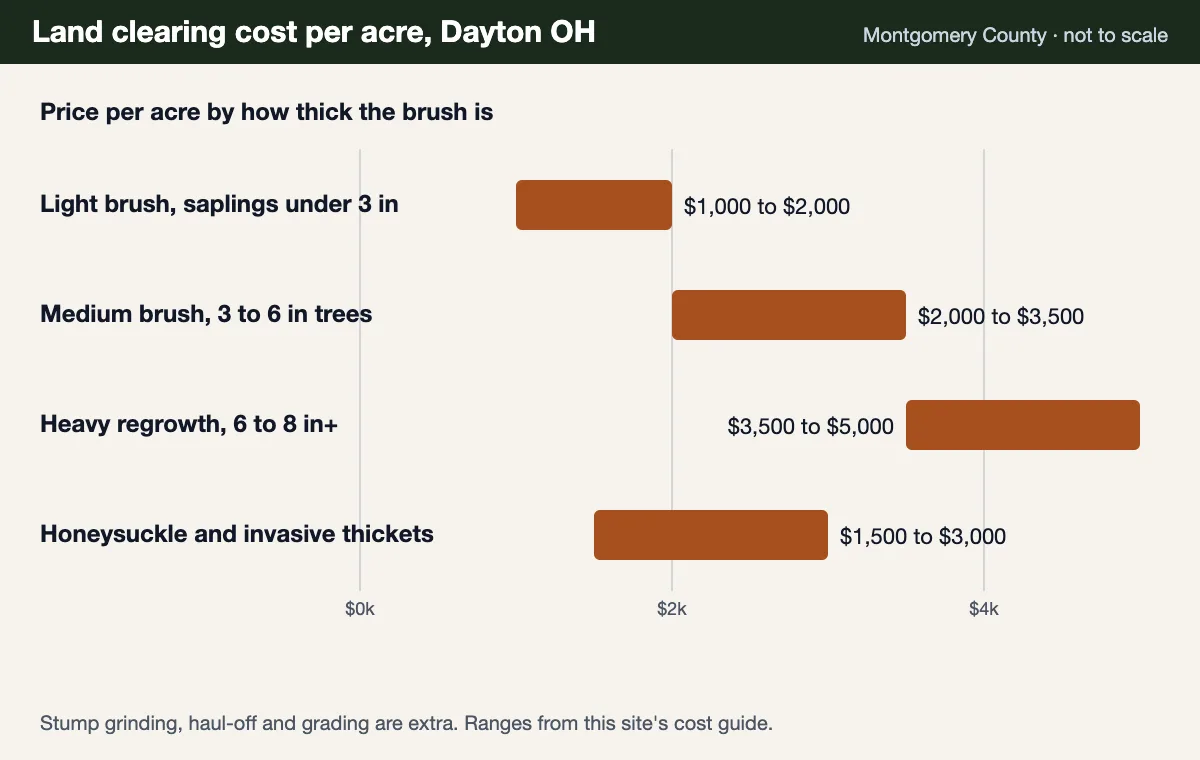
Most residential forestry mulching in Ohio runs $1,500 to $3,500 per acre, with published Ohio ranges of $1,000 to $2,000 per acre for light brush and saplings under 3 inches, $2,000 to $3,500 for medium brush carrying 3 to 6 inch stems, and $3,500 to $5,000 or more for heavy regrowth at 6 to 8 inches and above. Stem diameter and stems per acre drive the number far more than total acreage does. Small jobs usually meet a mobilisation minimum of $500 to $1,000 instead, because moving a tracked machine to the property costs the same whether it works a quarter acre or two.
Published Ohio per acre ranges: $1,000 to $2,000 for light brush up to $3,500 to $5,000 for heavy regrowth.
Is forestry mulching worth it in Dayton?
In Dayton it usually is, because the two alternatives are both restricted here. Open burning is generally prohibited inside Dayton city limits unless a permit has been issued, and Ohio EPA treats land clearing waste burning as something that needs written permission from the agency even outside city limits. That leaves hauling, which means chipping or loading every stem, trucking it, and paying tipping fees. Mulching processes the same material where it stands and leaves it on the ground as a chip layer, so you pay once for one machine instead of paying for cutting, loading, trucking and disposal.
Does honeysuckle grow back after mulching?
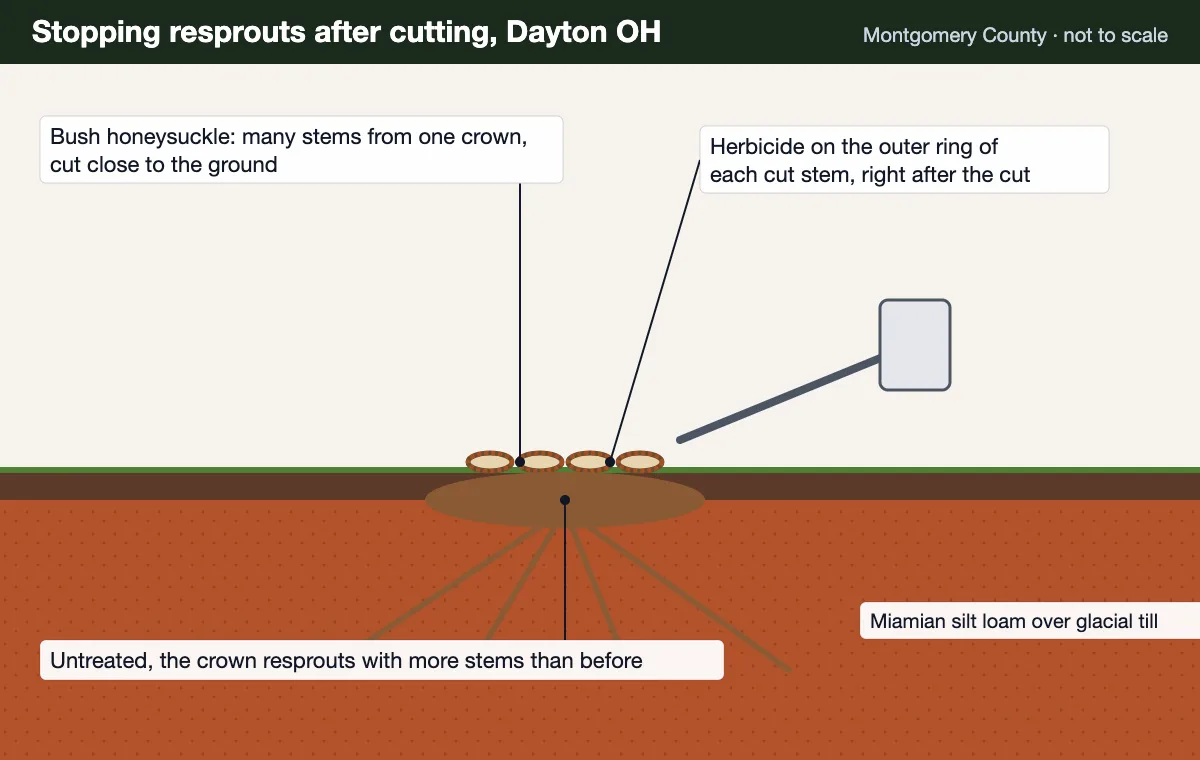
Yes, bush honeysuckle can and usually does resprout after it is cut or mulched. OSU Extension is explicit that simply cutting the shrub off at the base will cause prolific sprouting and increase the number of stems, because the root crown survives and pushes new growth. Anyone promising that one mulching pass eradicates a honeysuckle stand is overselling it. A realistic plan is mulching to knock the thicket down and open the site, then follow up treatment of the cut stumps or the regrowth, and monitoring for at least a year, which is the window OSU recommends.
How much does honeysuckle removal cost?
Invasive thicket work in Ohio is published at $1,500 to $3,000 per acre, sitting inside the general mulching range because honeysuckle stems are small but extremely dense. A typical suburban back lot in Kettering or Centerville is well under an acre, so those jobs usually land on the $500 to $1,000 mobilisation minimum rather than a per acre figure. Budget separately for follow up, because the first pass clears the stand and the second season is what actually keeps it down.
Honeysuckle resprouts from the crown; treating each fresh-cut stem is what stops it.
Do I need a permit to clear land in Ohio?
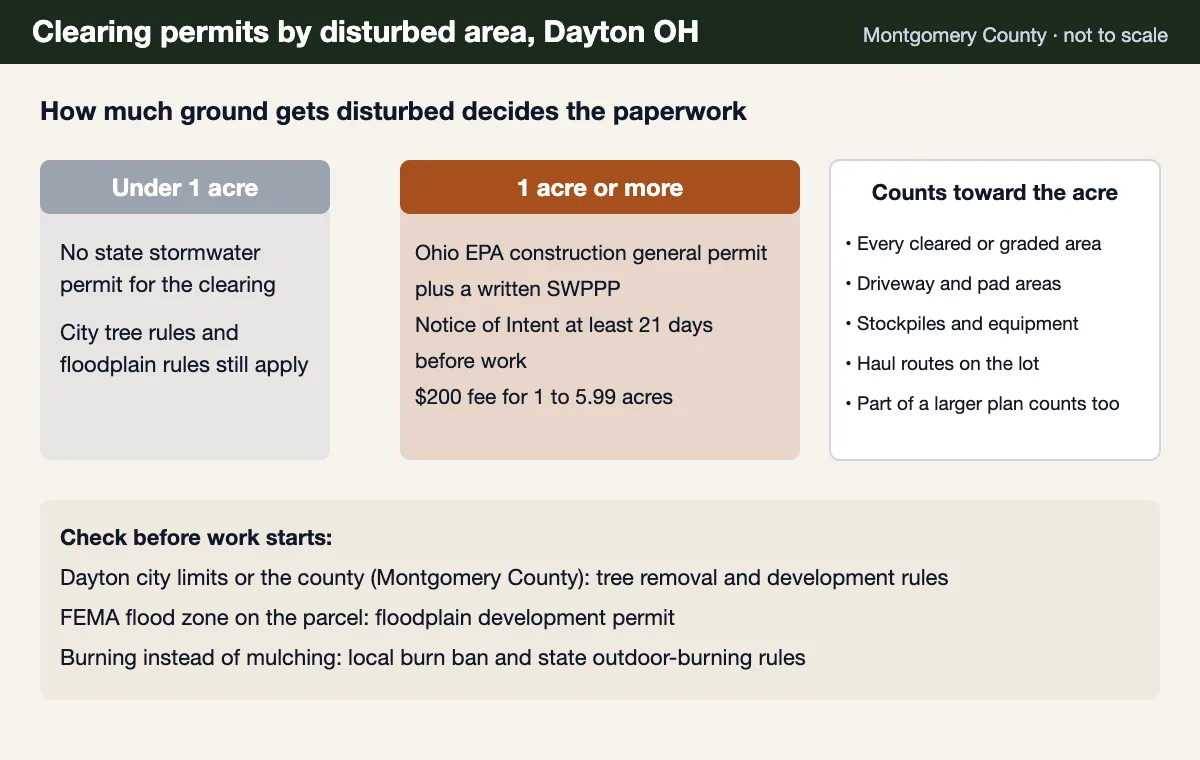
You need an Ohio EPA construction stormwater permit if your project disturbs one acre or more, or is part of a larger common plan of development or sale that will ultimately disturb one acre or more, and stormwater from it reaches waters of the state. Ohio EPA’s own small business guidance states that clearing and grubbing activities are considered land disturbance, so clearing ahead of construction counts toward that acre. The Notice of Intent goes in at least 21 days before work starts, and the base fee for sites between 1 and 5.99 acres is $200. Maintenance style clearing that is not part of a construction project is treated differently, and local zoning or township rules can still apply on top.
Can I burn the brush instead of mulching it?
Not inside Dayton city limits without a permit. The City of Dayton states that open burning is generally prohibited within the city, with only a few exceptions or unless a permit has been issued. Outside municipal limits, Ohio EPA rules prohibit open burning of land clearing waste unless the agency gives written permission, require fires to be at least 1,000 feet from inhabited buildings, and the Ohio Department of Natural Resources bans open burning between 6 a.m. and 6 p.m. in unincorporated areas during March, April, May, October and November. That seasonal ban covers the exact months most people want to clear, which is a large part of why mulching in place has taken over here.
The acre threshold: one acre or more disturbed brings the Ohio EPA construction general permit and an NOI 21 days ahead.
How much land can a forestry mulcher clear in a day?
Expect roughly half an acre to two acres per day, depending almost entirely on density and stem size. Light saplings and briars in an open field edge move fast. A solid honeysuckle understory with thousands of stems per acre, or regrowth carrying 6 inch and larger material, sits at the slow end because the head has to reduce every stem rather than simply drive over it. Slope, wet ground and how much mature timber has to be worked around all pull the number down further.
Can I rent a forestry mulcher in Dayton instead of hiring one?
Rental mulching heads and carriers are available in the region, but the economics rarely favour a one off homeowner job. A mulching head is a high speed rotating drum throwing wood chips, it demands a high flow carrier, and operators build the feel for feed rate and head height over many hours. The realistic comparison is a rental day plus transport plus your own time against a contractor day rate, which Ohio sources put at $1,500 to $3,000 with the machine, the operator and the insurance included. We do not quote rental rates here because we have not verified a current local price we would stand behind.
When is the best time of year for forestry mulching in the Miami Valley?
Late fall through winter is usually the best window here, for two reasons. Visibility is the first: once the canopy drops its leaves you can actually see the stand, and bush honeysuckle stays green well after the natives go dormant, which makes an infestation obvious. Ground condition is the second: the Miami soil series that runs through this drainage sequence carries a perched seasonal high water table 2 to 3 feet down from December through April, so saturated stretches in that window will rut under a tracked machine. Frozen or firm ground in the same season is ideal. In practice we watch the forecast more than the calendar.
What is forestry mulching?
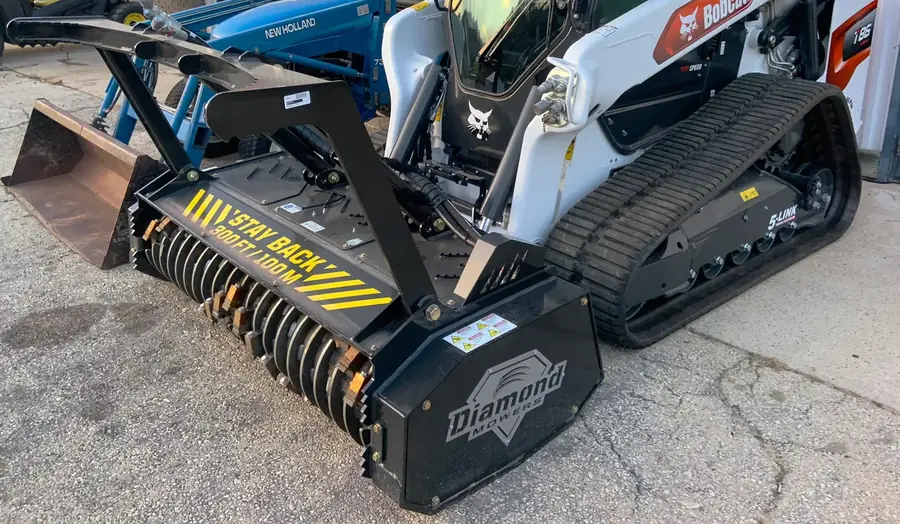
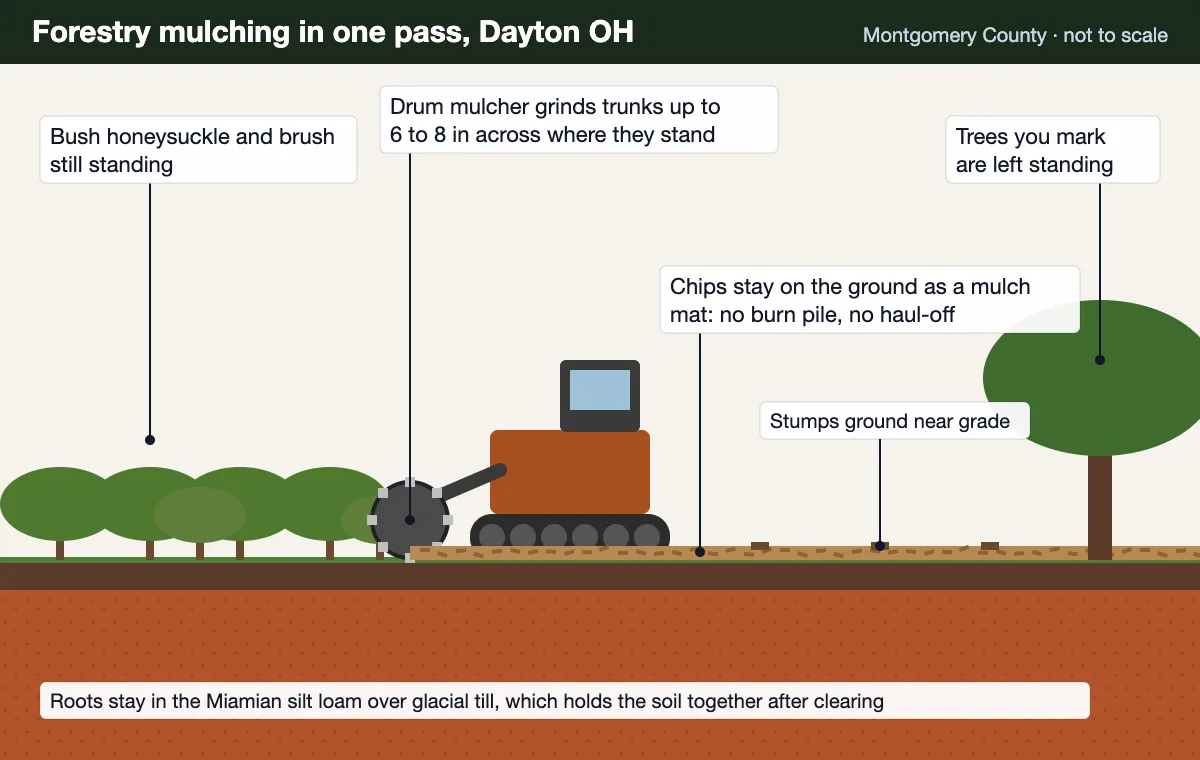
Forestry mulching is the reduction of standing vegetation to wood chip on site, in one operation, using a high speed rotating drum or disc head mounted on a tracked carrier or an excavator. Instead of cutting, stacking, loading and hauling, the machine grinds brush, briars and saplings where they stand and leaves the material on the ground as a chip layer. It is a single machine doing what previously took a crew, a chipper, a truck and a disposal site.
Forestry mulching in one picture: brush ground where it stands, chips left on the ground, marked trees kept.
Will forestry mulching kill the trees I want to keep?
No, and keeping specific trees is one of the main reasons people choose mulching over a dozer. The head works on the material you point it at, so mature trees can be left standing with the understory taken out from beneath them. We flag the keepers before the machine moves. The practical limit is access: a keeper in the middle of a dense stand means the operator has to work around it, which slows the job and shows up in the day count.
How deep is the mulch layer left behind?
It depends entirely on how much material there was, which is the honest answer. A light field edge leaves a thin scatter. A decade of dense understory on a wooded parcel can leave several inches of coarse chip, because all of that standing biomass has to go somewhere and the whole point is that it stays on your ground. It settles noticeably over the first season or two. On slopes that layer is an asset, since it keeps disturbed soil from washing after a storm.
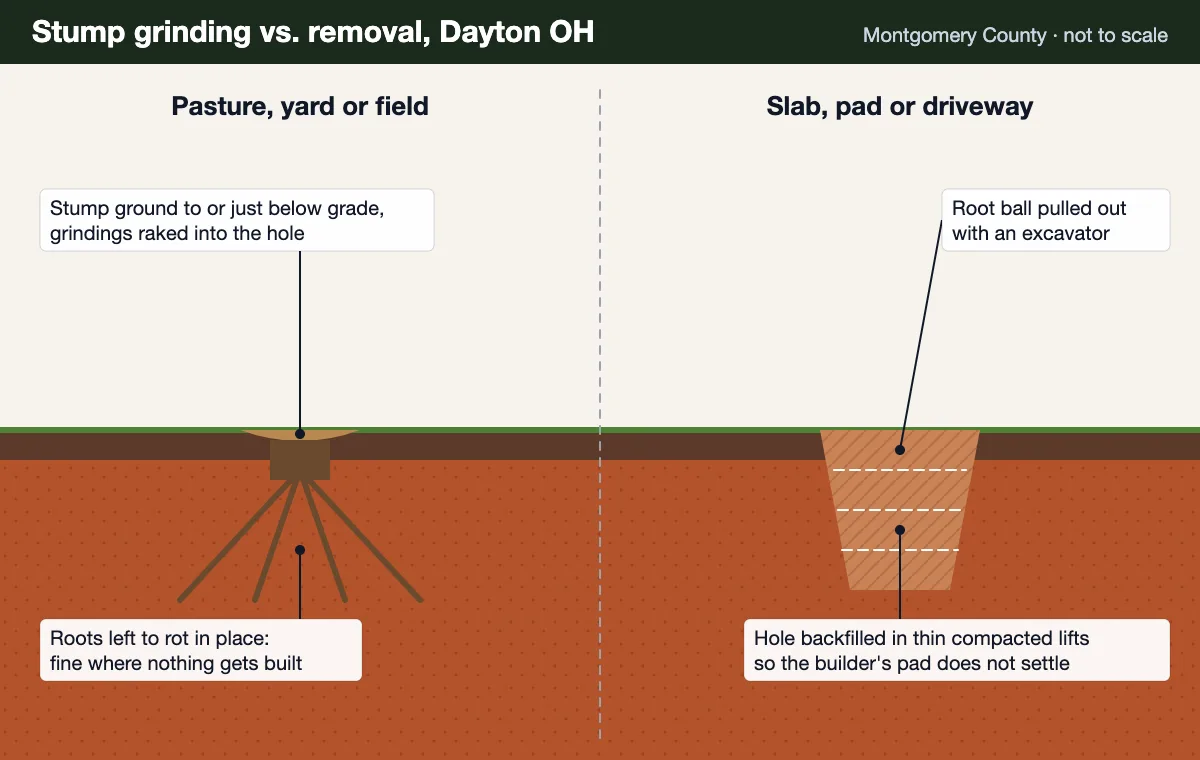
Does forestry mulching remove stumps?
No. Forestry mulching processes standing material at or just above ground level and leaves the stump and root mass in place. That is exactly why OSU Extension’s guidance on cutting invasive shrubs matters so much here: the root crown is still alive and will push new stems unless it is treated. If you need a site cleared down to bare soil with roots out, that is grubbing and excavation work, which is a different scope, a different machine and the point at which the Ohio EPA one acre construction stormwater question becomes live.
Mulching grinds stumps near grade; pulling them out for a pad is a separate excavation step.
Send the property address and a line about what you are looking at. Most clearing questions in the Miami Valley have a specific answer once someone has walked the ground.